
.png)

Intelligent Control Systems Driven by Advanced Modeling
Model-Based Controls & Software Development
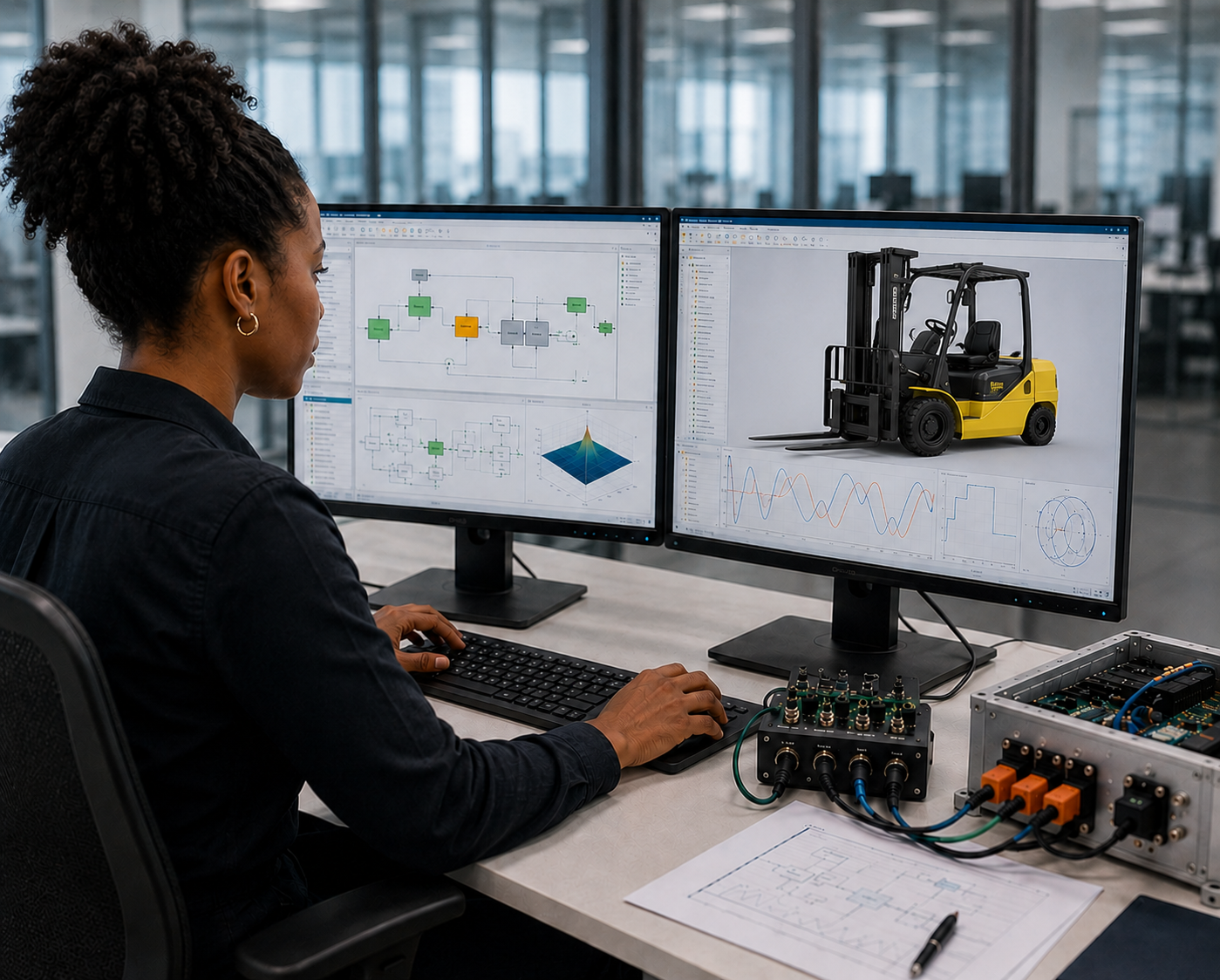
TwinElectra helps customers accelerate the development of advanced control systems through a Model-Based Design (MBD) approach that enables engineers to move efficiently from concept to production-ready software.
By developing executable models of physical systems and control algorithms, engineering teams can design, simulate, validate, and optimize control strategies in a virtual environment before deploying them to hardware. This approach reduces development risk, shortens validation cycles, and improves overall system performance and reliability.
Our expertise spans electrified powertrains, electric machines, power electronics, energy management systems, hydraulic systems, industrial automation, and power generation applications.
Control System Development Capabilities
- Control architecture development and requirements analysis
- Dynamic system modeling and plant development
- Closed-loop control design and tuning
- State estimation and observer design
- Supervisory control and energy management systems
- Fault detection, diagnostics, and fault-tolerant controls
- Functional safety-oriented control strategies
- Real-time control implementation and optimization
Electrification and Power Systems Expertise
TwinElectra has extensive experience developing advanced controls for:
- Induction motor drives
- Permanent magnet synchronous motors (PMSM)
- Synchronous generators
- Inverter and power electronics control
- Battery management and energy storage systems
- Vehicle electrification systems
- Hybrid and electric powertrains
- Generator synchronization and power management systems
- Microgrids and distributed energy systems
Our expertise includes Field-Oriented Control (FOC), Direct Torque Control (DTC), sensorless control, Maximum Torque Per Ampere (MTPA), energy optimization, and advanced power management strategies.
Virtual Validation and Auto-Code Generation
Using industry-leading Model-Based Design tools, we enable:
- Software-in-the-Loop (SIL) testing
- Processor-in-the-Loop (PIL) testing
- Hardware-in-the-Loop (HIL) validation
- Automatic code generation
- Calibration and parameter optimization
- Requirements traceability and verification
This approach allows control algorithms to be validated against high-fidelity plant models long before prototype hardware is available, significantly reducing integration and commissioning risks.
AI-Enhanced Control Development
TwinElectra combines traditional control theory with modern AI and data-driven techniques to improve system performance and accelerate development. Our solutions leverage machine learning, optimization algorithms, and operational data to support controller tuning, anomaly detection, predictive diagnostics, and adaptive control strategies.
Delivering Faster, More Reliable Control Systems
By integrating physics-based modeling, advanced control design, virtual validation, and automated software deployment, TwinElectra enables customers to develop robust control systems faster while improving product performance, reliability, and time-to-market.